A Filter That Removes Itself
qdrant-client's local mode accepted a min_should min_count of zero and returned every point in the collection. The server refuses the same query outright. Third fix merged into the library — and the third one found the same way.
A filter is supposed to narrow a result set. This one widened it to everything, and told nobody.
min_should in Qdrant lets you say "at least N of these conditions must hold". Set
min_count to zero in local mode and you get the entire collection back. Not an error, not
an empty result — every point you have.
The server rejects the same query with a 422.
PR #1369 is merged. It is the third
fix of mine in qdrant-client, and all three were found the same way.
The two-line reproduction
from qdrant_client import QdrantClient, models

client = QdrantClient(":memory:")
client.create_collection(
    "t", vectors_config=models.VectorParams(size=2, distance=models.Distance.COSINE)
)
client.upsert("t", points=[
    models.PointStruct(id=i, vector=[0.1 * i, 0.1 * i], payload={"a": i})
    for i in range(1, 6)
], wait=True)

flt = models.Filter(
    min_should=models.MinShould(
        conditions=[models.FieldCondition(key="a", match=models.MatchValue(value=1))],
        min_count=0,
    )
)

records, _ = client.scroll("t", scroll_filter=flt, limit=10)
print([r.id for r in records])
# local mode  -> [1, 2, 3, 4, 5]
# server      -> 422 Unprocessable Entity
One point matches the condition. Local mode returns five.
Only the bottom of the range diverges
I ran the same filter against Qdrant 1.19.0 in Docker across a range of min_count values,
two conditions, three points.
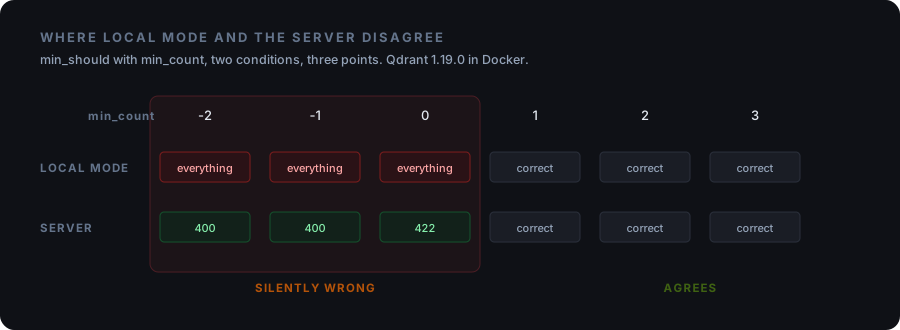
At one and above, the two agree exactly. Below one they diverge completely, and in opposite directions: the server refuses to answer, local mode answers with everything.
That shape matters. A bug that fires on every input gets caught on the first run. A bug that only fires on an edge nobody tests survives for years, because the middle of the range behaves perfectly and gives you every reason to trust it.
The cause is one comparison
From qdrant_client/local/payload_filters.py:
def check_min_should(conditions, payload, point_id, vectors, min_count) -> bool:
    return (
        sum(check_condition(c, payload, point_id, vectors) for c in conditions)
        >= min_count
    )
That is a correct implementation of "at least N matched" for any sensible N. The problem is not the comparison; it is that nothing upstream ever asked whether N was sensible.
With min_count at zero, sum(...) >= 0 is true for every point in the collection,
including points where not a single condition matched. The filter evaluates successfully
and selects everything. There is no error path because, as far as the code is concerned,
nothing went wrong.
Why "returns everything" is the worst possible failure
If local mode had thrown, you would fix it in the minute you wrote it.
If local mode had returned nothing, you would notice immediately — an empty page is loud.
Returning everything is quiet. Your tests pass because the points you expected are in the result; they are simply accompanied by every other point. A search page looks populated. A RAG retrieval returns context. A permissions filter that was meant to scope results to one tenant returns all tenants, and the response still looks like a normal response.
Local mode is what people develop against. It is the fast one, the one with no Docker container, the one in CI. So the failure mode is: written locally, passes locally, passes review, reaches production, and there hits a server that refuses the query outright. The best case is a 422 on deploy day. The worse case is that the same silent widening exists in some other client path nobody has compared yet.
This is the same class as #1349, where local mode accepted datetime strings the server rejects. Two independent instances of the same underlying gap: local mode implements the happy path faithfully and validates nothing.
The fix goes before the scan, not inside it
The obvious patch is a guard inside check_min_should. It is also the wrong place — that
function runs once per point, so a collection of a million points would perform the same
check a million times to answer a question about the query.
Validation belongs where the query is accepted, not where each point is tested.
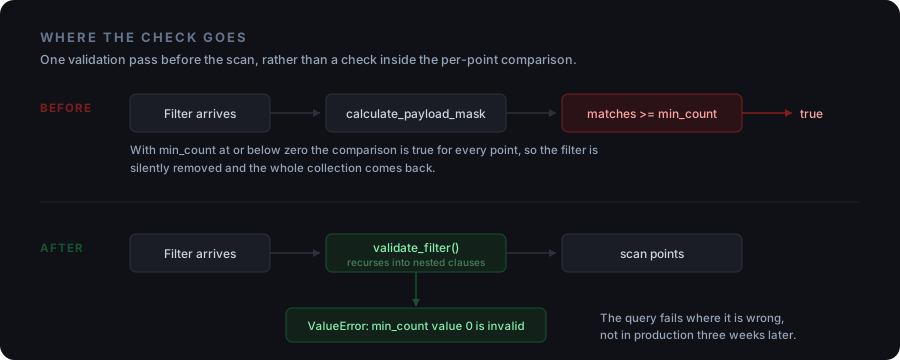
So the fix is a validate_filter() helper in payload_filters.py, called once from
calculate_payload_mask before the scan begins. It recurses into nested filters, because a
bad min_count buried inside a nested must clause is exactly as invalid as one at the
top level and considerably easier to miss.
The error matches the shape of the limit validation already in qdrant_local.py, so it
reads like the library rather than like a patch:
min_count value 0 is invalid. Must be 1 or larger.
What I could not fix, and said so
LocalCollection.scroll returns early when the collection is empty, before any filter code
runs. An invalid filter against an empty collection is therefore still accepted.
Catching that case means validating in each entry point rather than in one place, which is a larger change with more surface area, and I did not think it was mine to make unilaterally in a first patch. It is in the PR description as a known limitation.
Saying what a fix does not cover is not a weakness in a pull request. A maintainer's first question is always "what else does this touch", and answering it before it is asked is faster for both of you.
The method, for the third time
I did not read the source looking for this. All three merged fixes came from the same approach, which I have written about before:
Find a library with two implementations that are supposed to agree — local mode against a
real server, in-memory against Postgres, invoke against ainvoke. Write thirty small
probes aimed at the edges rather than the middle: zero, negative, empty list, empty string,
contradictory range, limit of a million. Run both sides. Print a table. Read the rows where
the two disagree.
The convenience implementation is the one nobody runs in production, so it is the least exercised and holds the most bugs. Every one of the three qdrant fixes lives in local mode.
The step people skip is verifying the harness before believing it. I have had a probe report three bugs that were all defects in my own test rig, and a day spent chasing them teaches you to prove the harness right on a case with a known answer before trusting it on one without.
What this does not solve
- Empty collections still accept an invalid filter, as above.
- Only
min_countis validated. Other filter values may have the same gap; I checked this one because a probe flagged it, not because I audited the filter surface. - This is a client-side fix. It makes local mode agree with the server; it does not change what the server does.
- Local mode and the server can still diverge in ways nobody has compared. Two found so far in this area is not evidence there are only two.
Try this on a library you depend on today
- Pick a library where you use a convenience mode — in-memory, local, Lite, a fake.
- Write down what the "real" implementation is. If there isn't one, this method does not apply and you need a different approach.
- Write twenty probes at the edges: zero, negative, empty, one-past-the-end, contradictory. Not the middle of the range — the middle is what the tests already cover.
- Run both sides and print a table. Do not eyeball it; diff it.
- Before you believe a disagreement, feed the harness a case whose answer you already know and confirm it reports that correctly.
- When you file it, lead with the reproduction and state what your fix does not cover.
Three merged fixes in this library so far: #1293 (shipped in v1.19.0), #1333, and #1369. The probes are public at github.com/nazsats.